
Deep cut
Tuesday, November 3, 2026
Walt Whitman's last house - the little place on Mickle Street
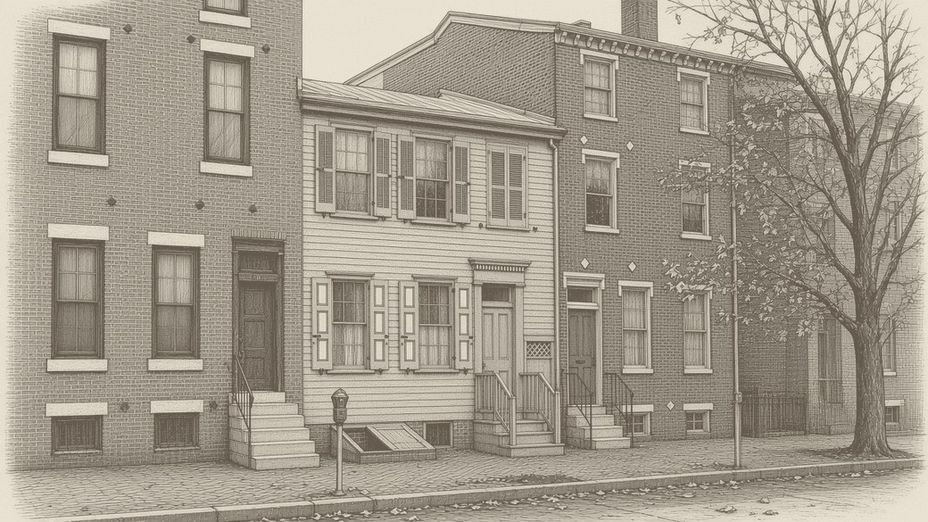
You've driven past the Walt Whitman Bridge a thousand times. Fewer of us have been to the house where Whitman actually lived, a modest two-story frame house on what's now Mickle Boulevard in Camden, a few blocks from the PATCO stop.
You've driven past the Walt Whitman Bridge a thousand times. Fewer of us have been to the house where Whitman actually lived, a modest two-story frame house on what's now Mickle Boulevard in Camden, a few blocks from the PATCO stop. It's the only house he ever owned, and he died in it.
It's closed right now for a big restoration, so this is a good winter to learn the story and save the visit for 2027.
He wasn't supposed to stay
Whitman came to Camden in 1873 and moved in with his brother George and George's wife Louisa on Stevens Street. According to the Walt Whitman Association, when George and Louisa decided to move to a farm in rural Burlington, Walt chose to stay put. The Whitman Archive says that choice caused a rift between the brothers.
He later summed up his time here in a line the Association still puts at the top of its page about the house:
"Camden was originally an accident, but I shall never be sorry I was left over in Camden. It has brought me blessed returns."
A $1,750 house
In 1884 Whitman bought the house on Mickle Street for $1,750. The 1882 edition of "Leaves of Grass" had sold surprisingly well, and the Whitman Archive says he put down $1,250 he'd earned in royalties and borrowed the other $500 from George W. Childs. The address back then was 328 Mickle Street. It was renumbered to 330 later on.
A poet living alone in an empty house needed help, so he made a deal. The Association says Mary O. Davis, a sea captain's widow who was renting a house on nearby West Street, agreed to move in with her own furniture, rent free, and keep house for him. He covered living expenses and paid her a small salary. She stayed with him until he died there on March 26, 1892, at 72.
Famous company
By the time Whitman settled on Mickle Street, he was famous well beyond Camden. The Association says Bram Stoker, the guy who'd go on to write "Dracula," and Oscar Wilde both came to Camden to visit him.
He also got close with Thomas Eakins, the Philadelphia painter. Eakins photographed Whitman and painted his portrait, so a lot of the images of old, bearded Whitman you've seen probably trace back to that friendship across the river.
What's inside
The house is a National Historic Landmark, and it's full of the real stuff. The Association lists Whitman's original letters and personal belongings, the bed he died in, and the death notice that was nailed to the front door. There's also a collection of rare 19th century photographs, including the earliest known image of Whitman, an 1848 daguerreotype.
According to the Whitman Archive, the City of Camden bought the house in 1921 and the State of New Jersey took it over in 1946. It's a state historic site today, with the Association helping support it.
Why it's closed
The Association says the house closed on December 1, 2025 for major renovations, including a new visitor center, with a target of reopening in summer 2027. State Treasury records show the contract for the Walt Whitman House Visitor's Center Rehabilitation went to Daniel J. Keating Company on January 22, 2026, for $9,770,115.
When it was open, general admission was free and visits were by guided tour, so I'd expect to call ahead again when it reopens. The site's number is (856) 964-5383.
Go see the tomb instead
Whitman is buried a couple of miles away at Harleigh Cemetery, 1640 Haddon Avenue in Camden. The Association says he was told he could pick any spot he wanted. He picked a quiet corner and a grand stone tomb with a design inspired by the poet and artist William Blake, and Whitman drew the first sketch himself. Some people at the time thought a giant tomb was a funny choice for a guy who wrote about a spear of summer grass. He did it anyway.
Getting there by train is easy. The Association's directions say to take PATCO one stop from Broadway to Ferry Avenue, walk a block north and cross Haddon Avenue to the cemetery. Call Harleigh at (856) 963-3500 before you go to check the gate hours.
The short version
Walt Whitman spent his last eight years in a modest frame house in Camden that he bought for $1,750, and the bed he died in is still upstairs. The house is closed for a state rehab until a target of summer 2027, so for now, take PATCO to Ferry Avenue and say hi at the tomb he sketched for himself.