
Deep cut
Monday, October 26, 2026
Hadrosaurus Park - the Haddonfield ravine where the world's first mounted dinosaur came out of the ground
Every kid in Haddonfield grows up climbing on, or at least next to, a bronze dinosaur on Kings Highway. I'd walked past Haddy a hundred times before I ever asked the obvious question, which is why a dinosaur, and why here.
Every kid in Haddonfield grows up climbing on, or at least next to, a bronze dinosaur on Kings Highway. I'd walked past Haddy a hundred times before I ever asked the obvious question, which is why a dinosaur, and why here. The answer is about a mile away at the end of Maple Avenue, in a wooded ravine most people in town have never walked down to.
That ravine is Hadrosaurus Park. It's tiny and a little scruffy, and it's also a National Historic Landmark. Here's the story of how a muddy hole on a Haddonfield farm changed what the whole world thought a dinosaur looked like.
Before it was a park, it was a marl pit
In the 1800s, farmers around here dug marl, a sticky greenish clay full of fossil shells, out of the ground and spread it on their fields as fertilizer. The National Historic Landmark nomination for the site says that around 1838, marl diggers on John E. Hopkins' farm in Haddonfield hit some huge black bones. Nobody knew what they were. Hopkins gave a few away to curious neighbors and kept some, and over the next 20 years every one of them went missing.
The reason that marl was full of shells is the wild part. The nomination says that about 80 million years ago, this part of New Jersey sat under the Atlantic, with as much as 100 feet of water over what's now Haddonfield. The Academy of Natural Sciences puts the dinosaur at about the same age. The animal most likely died somewhere along the coast and washed out to sea, which is why a land dinosaur ended up buried with clams.

The summer a Philly lawyer went digging
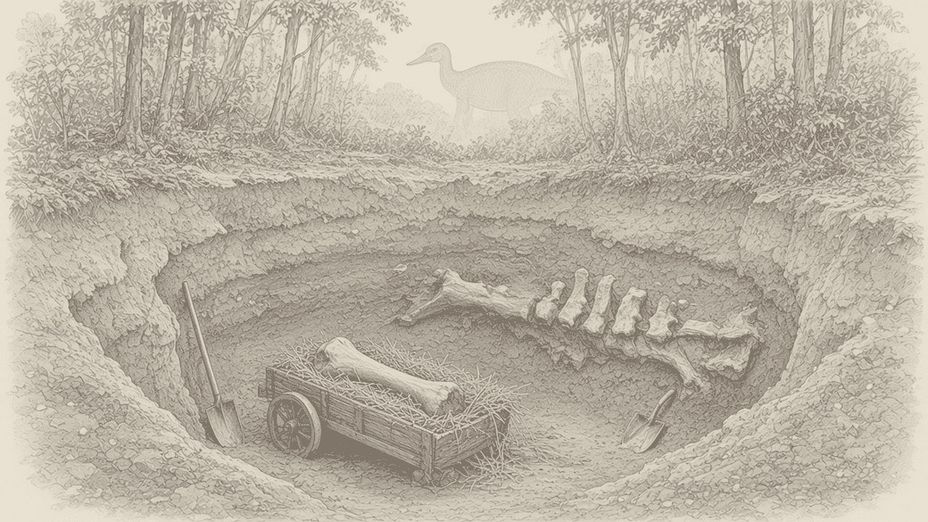
In 1858, a Philadelphia lawyer and amateur scientist named William Parker Foulke was spending the summer in Haddonfield with his family. Hopkins told him about the old bones. Foulke got permission to reopen the pit, and according to the nomination, Hopkins told him he could dig anywhere on the farm and keep whatever he found.
They found the old pit, worked over to the side where Hopkins remembered the bones, and went down about nine or ten feet through fill, marl and shell beds until they hit a pile of bones. Foulke dug carefully for the time. He sketched the bones in place before lifting them, wrapped each one in cloth, and hauled them on a bed of straw in a cart to the house where he was staying. On Oct. 5, 1858, he wrote to Joseph Leidy at the Academy of Natural Sciences in Philadelphia asking him to come out. The letter, quoted in the nomination, says he feared "the incursions of the neighbors who are roused on the subject." Haddonfield has always been a town that shows up.
Leidy stands the dinosaur up
Leidy, a University of Pennsylvania anatomy professor, studied the bones and named the animal Hadrosaurus foulkii, after the man who dug it up. The Academy says he named and described it in 1859. The big insight came from the legs. The nomination says Leidy saw the thigh bone was about 40 percent longer than the upper arm bone, so the animal could rear up on its hind legs. At the time, the leading idea from Britain was that dinosaurs were heavy, elephant-like animals that walked on all fours. A pile of bones from Haddonfield helped knock that over.
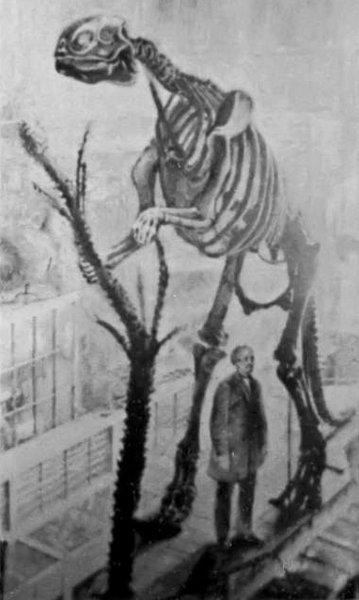
In 1868, the British artist Benjamin Waterhouse Hawkins built a full skeleton under Leidy's direction, using casts and filling in what was missing. There was no skull, so they borrowed the look of an iguana's head. The Academy, the nomination and the borough all say the result was the first mounted dinosaur skeleton anyone could go see, anywhere in the world. The Academy says the crowds were so big it started charging admission for the first time, ten cents.

Myth check: "the first complete dinosaur"
You'll hear in Haddonfield that this was the first complete dinosaur skeleton ever found. The NHL nomination and the state's 1991 law both say it was the first nearly or relatively complete dinosaur skeleton found anywhere. The Academy itself is more careful and says only a portion of the animal was found, with no skull. Both can be true. It was the most complete one anyone had found by 1858, and it was still missing its head. "First mounted dinosaur" is the claim every source agrees on, so that's the one I'd use at a party.
How a ravine became a landmark
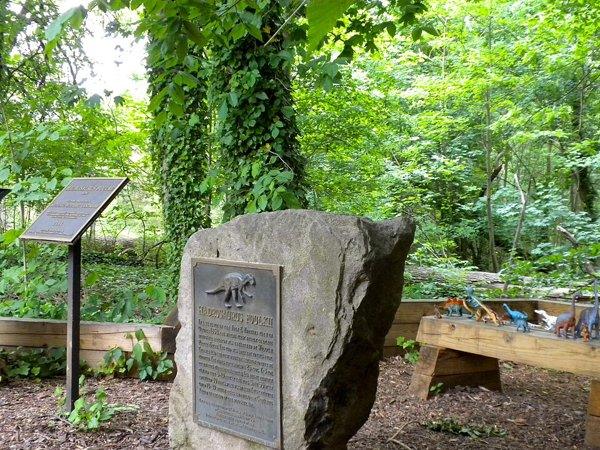
For more than a century, almost nobody went looking for the spot. That changed in 1984, when an Eagle Scout named Christopher Brees and Haddonfield's Troop 65 built a small commemorative park at the end of Maple Avenue, with a stone marker and plaque. The nomination dates the dedication to Sept. 23, 1984, and the historical marker at the site still credits the Eagle project.
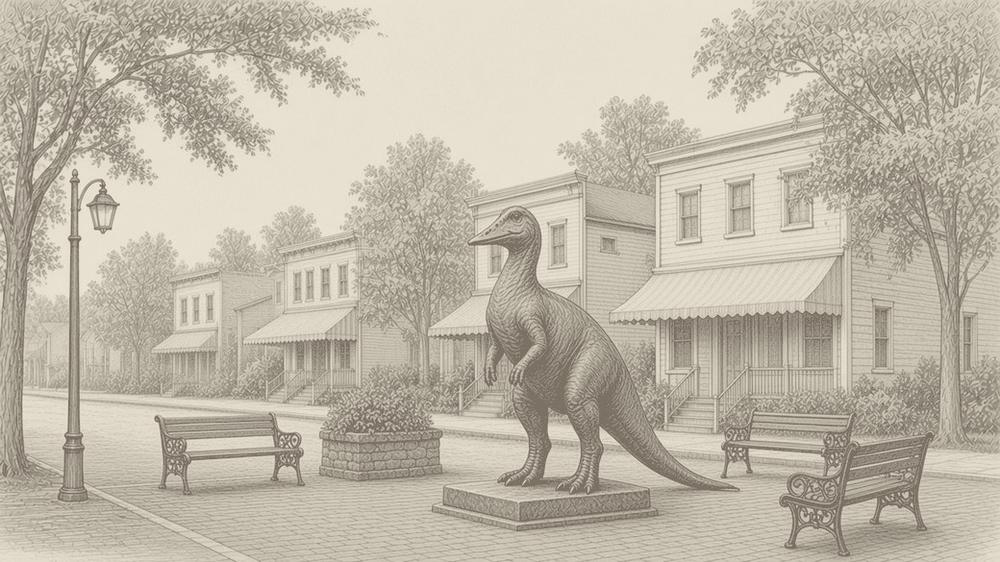
Then the kids got involved. Fourth graders at Strawbridge School in Westmont, with their teacher Joyce Berry, campaigned to make Hadrosaurus the state dinosaur. Gov. Jim Florio signed the bill in 1991, and the borough and the nomination both tell that story. The site was named a National Historic Landmark in 1994. Downtown, the Haddonfield Garden Club started the project that became John Giannotti's bronze Haddy, which CBS Philadelphia measures at 8 feet tall and 18 feet long.

Visiting Hadrosaurus Park
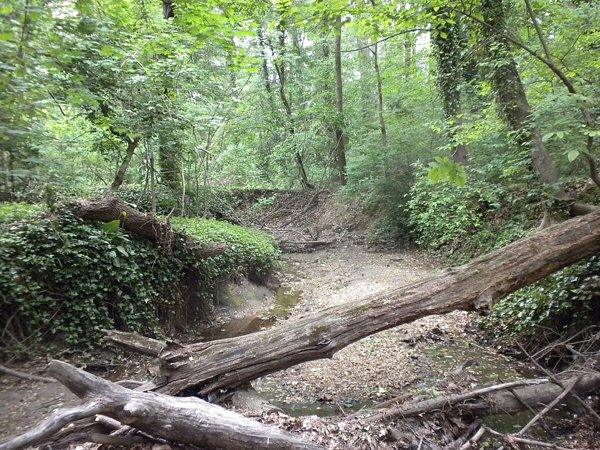
Head to the east end of Maple Avenue. The little park has the Eagle Scout marker, the landmark plaque and some signs. The nomination places the actual dig about 330 feet up the stream it calls Hadrosaurus Run, in an overgrown hollow, and it's not a marked trail, so wear real shoes and don't go scrambling down a muddy bank in the dark. Then drive or walk back to Kings Highway and Lantern Lane and say hi to Haddy.
One sad update. The Academy of Natural Sciences put a restored Hadrosaurus mount back in Dinosaur Hall in July 2025. But Drexel closed the Academy's Parkway museum as of Sept. 30, 2026, and NBC10 reported the last public day was Sept. 27. The university says the collections stay and it's looking at new ways to put them on display. For now, that makes the ravine on Maple Avenue and the bronze on Kings Highway the easiest places to visit Haddy.
The short version
A Haddonfield marl pit gave up a pile of bones in 1858. A Philly lawyer dug them out, Joseph Leidy figured out the animal stood on two legs, and in 1868 it became the first dinosaur skeleton the public could see standing up. Hadrosaurus Park, at the end of Maple Avenue, marks the spot.